Essential Oil - Peru Balsam
Essential Oil – Peru Balsam
Botanical Information
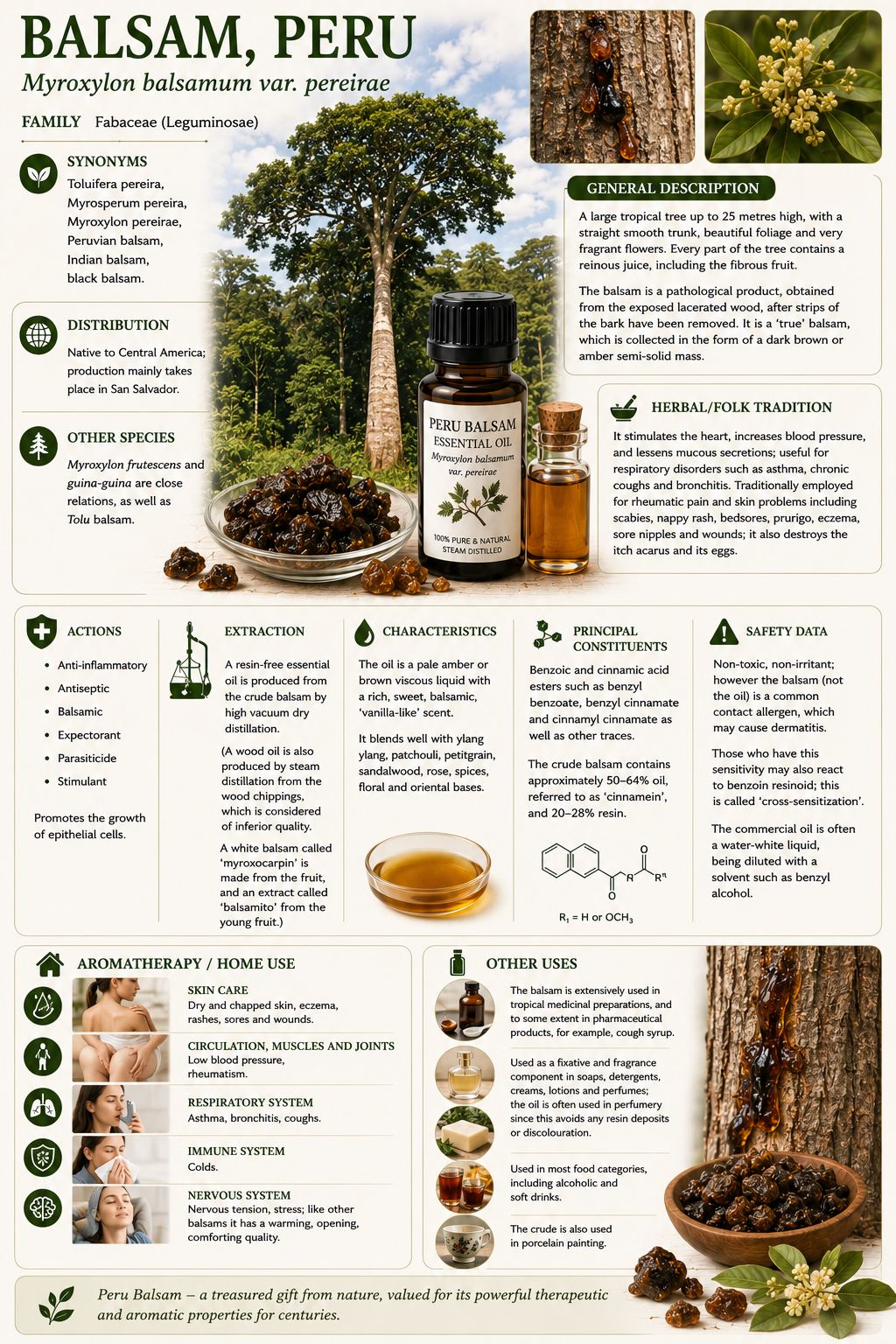
Peru Balsam (Myroxylon balsamum var. pereirae) belongs to the Fabaceae (Leguminosae) family and is a large tropical tree that can grow up to 25 metres in height. It has a straight, smooth trunk, dense foliage, and highly fragrant flowers. Every part of the tree contains a resinous juice, including its fruit. Unlike many essential oils, Peru Balsam is considered a true balsam, obtained as a pathological exudate from the exposed wood after sections of bark are removed. It is also known by several other names, including Toluifera pereira, Myrosperum pereira, Myroxylon pereirae, Peruvian balsam, Indian balsam, and black balsam.
Distribution and Traditional Uses
Peru Balsam is native to Central America, with the majority of commercial production taking place in El Salvador. Closely related species include Myroxylon frutescens, guina-guina, and Tolu balsam.
Traditionally, Peru Balsam has been valued for supporting cardiovascular and respiratory health by stimulating the heart, increasing blood pressure, and reducing excessive mucus production. It has long been used to relieve asthma, chronic coughs, and bronchitis. Externally, it has been applied to soothe rheumatic pain and a variety of skin conditions, including eczema, scabies, nappy rash, bedsores, sore nipples, wounds, and persistent itching. It has also been traditionally used to destroy itch mites and their eggs.
Essential Oil and Characteristics
Peru Balsam essential oil is obtained from the crude balsam through high-vacuum dry distillation, producing a resin-free essential oil. A separate wood oil can also be produced by steam distillation of the wood chips, although it is considered to be of lower quality. Additional products obtained from the tree include myroxocarpin, a white balsam extracted from the fruit, and balsamito, an extract obtained from young fruits.
The essential oil is a pale amber to brown, viscous liquid with a rich, sweet, warm balsamic fragrance that closely resembles vanilla. It blends exceptionally well with ylang-ylang, patchouli, petitgrain, sandalwood, rose, spices, floral oils, and oriental fragrance bases.
Chemical Composition
The principal constituents of Peru Balsam essential oil include benzyl benzoate, benzyl cinnamate, cinnamyl cinnamate, and other esters of benzoic and cinnamic acids. The crude balsam contains approximately 50–64% essential oil, known as cinnamein, together with 20–28% resin.
Therapeutic Benefits
Peru Balsam essential oil possesses anti-inflammatory, antiseptic, balsamic, expectorant, parasiticidal, and stimulant properties. It also promotes the regeneration of epithelial tissue, making it valuable in skin care. In aromatherapy, it is commonly used to soothe dry or chapped skin, eczema, rashes, sores, and minor wounds. It may also help support healthy circulation, relieve rheumatic discomfort, improve low blood pressure, and assist in managing respiratory conditions such as asthma, bronchitis, coughs, and colds. Its warm, comforting aroma is widely appreciated for easing nervous tension, stress, and emotional fatigue.
Safety and Precautions
Peru Balsam essential oil is generally considered non-toxic and non-irritating when used appropriately. However, the crude balsam is a well-known contact allergen and may cause allergic dermatitis in sensitive individuals. People allergic to Peru Balsam may also react to benzoin resinoid due to cross-sensitisation. Commercial essential oil is sometimes diluted with solvents such as benzyl alcohol, so purchasing from reputable suppliers is recommended.
Industrial Uses
Peru Balsam is widely used in tropical medicinal preparations and pharmaceutical products, particularly cough syrups and topical remedies. The essential oil serves as a valuable fixative and fragrance ingredient in perfumes, soaps, detergents, creams, and lotions because it provides the characteristic balsamic aroma without leaving resin deposits or causing product discolouration. It is also extensively used as a flavouring agent in confectionery, food products, alcoholic beverages, and soft drinks.