

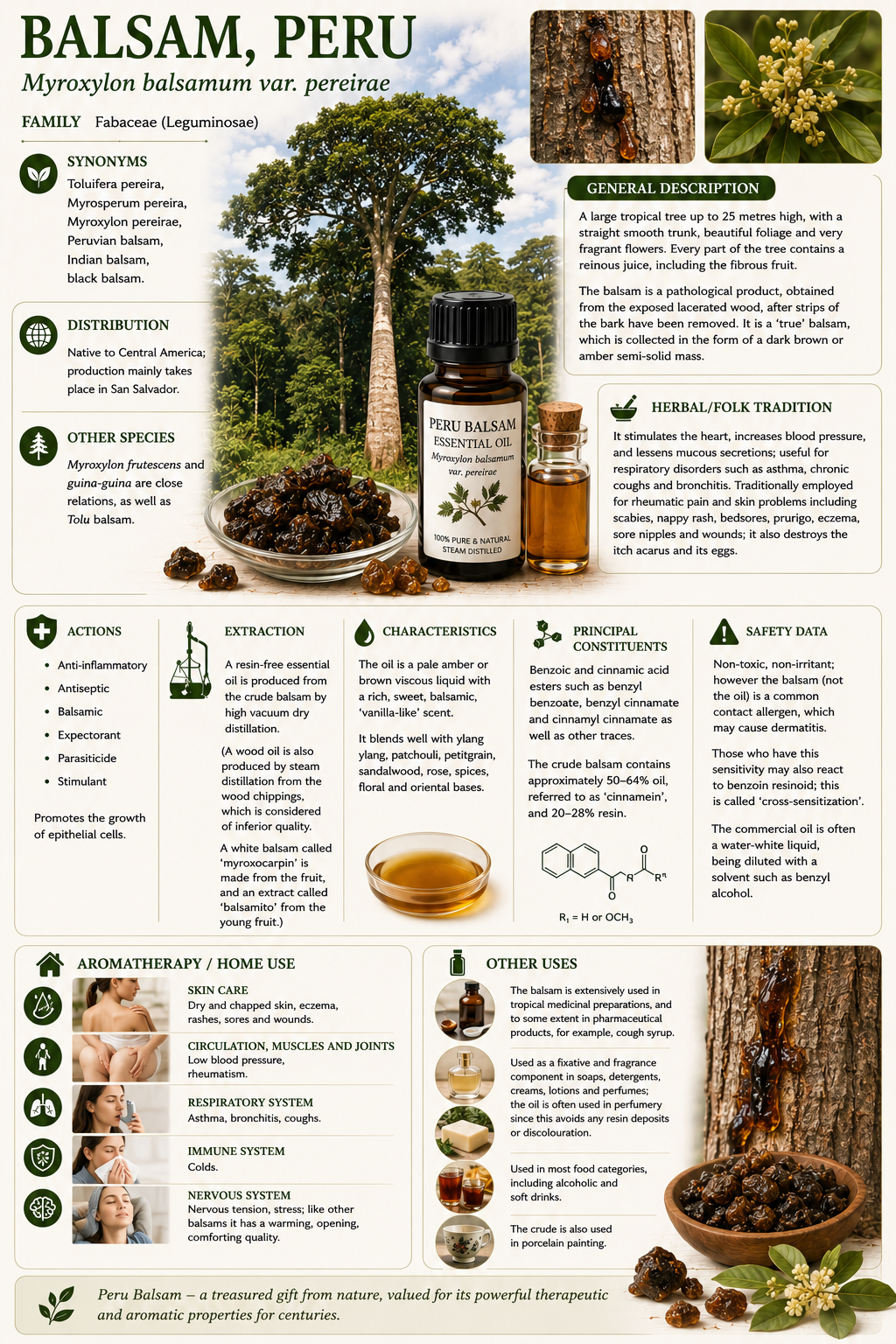
Essential Oil - Peru Balsam
Essential Oil – Peru Balsam
Botanical Information
Peru Balsam (Myroxylon balsamum var. pereirae) belongs to the Fabaceae (Leguminosae) family and is a large tropical tree that can grow up to 25 metres in height. It has a straight, smooth trunk, dense foliage, and highly fragrant flowers. Every part of the tree contains a resinous juice, including its fruit. Unlike many essential oils, Peru Balsam is considered a true balsam, obtained as a pathological exudate from the exposed wood after sections of bark are removed. It is also known by several other names, including Toluifera pereira, Myrosperum pereira, Myroxylon pereirae, Peruvian balsam, Indian balsam, and black balsam.
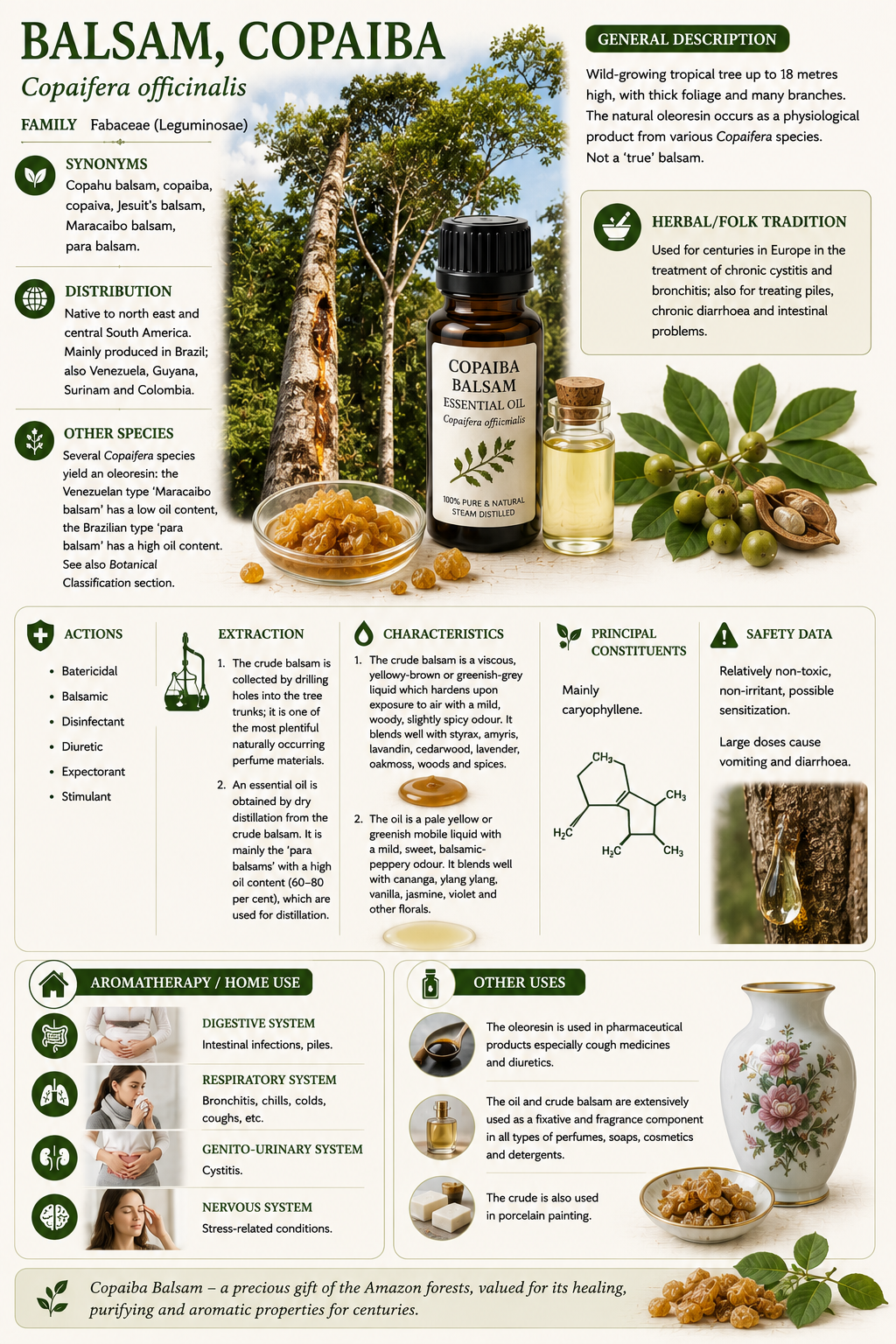
Essential Oil - Copaiba Balsam
Essential Oil – Copaiba Balsam
Botanical Information
Copaiba Balsam (Copaifera officinalis) belongs to the Fabaceae (Leguminosae) family and is a wild-growing tropical tree that can reach up to 18 metres in height. It has dense foliage and numerous branches, producing a natural oleoresin within its trunk. Although commonly referred to as a balsam, it is technically an oleoresin rather than a true balsam. The plant is also known by several other names, including copahu balsam, copaiba, copaiva, Jesuit’s balsam, Maracaibo balsam, and para balsam.
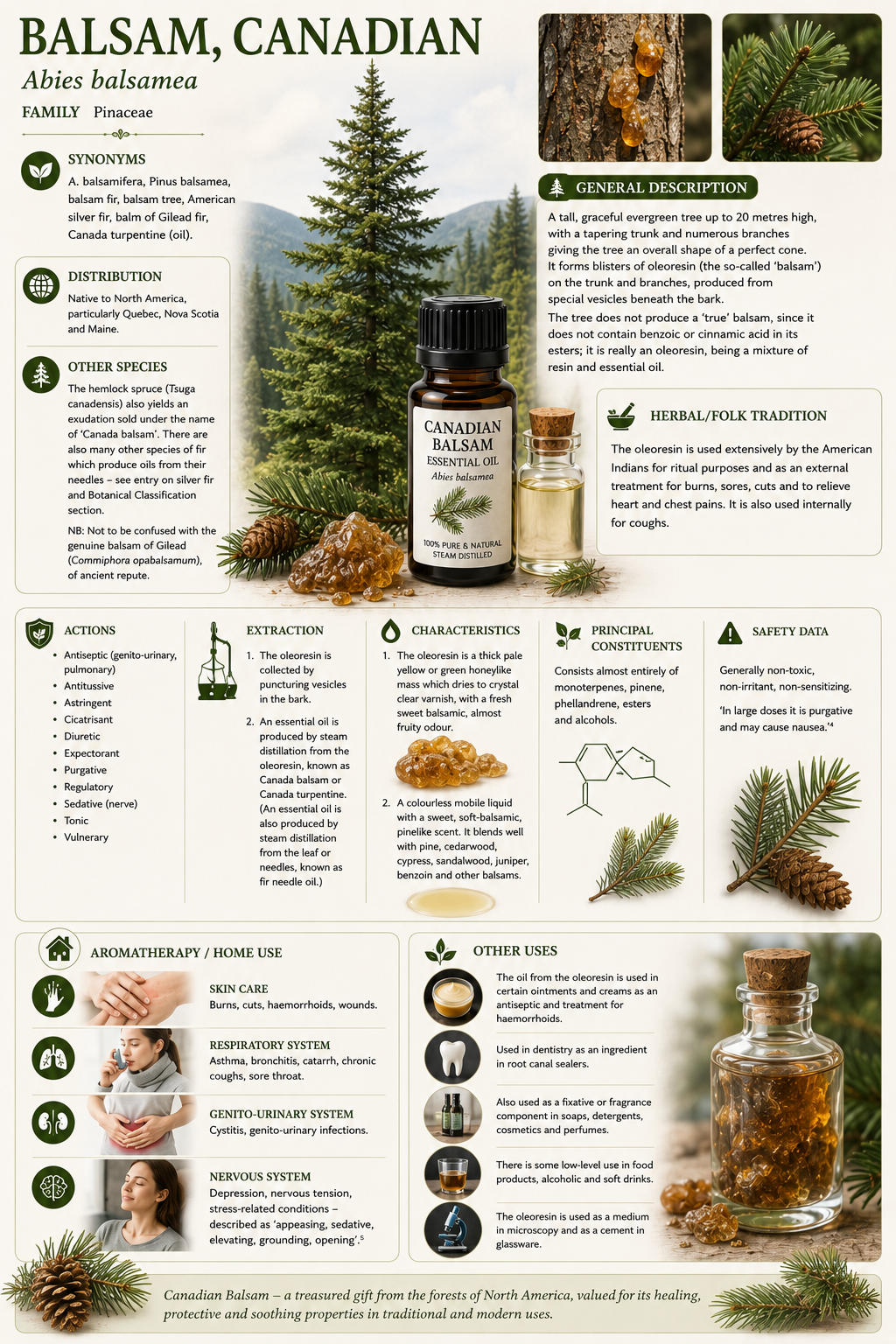
Essential Oil -Canadian Balsam
Essential Oil – Canadian Balsam
Botanical Information
Canadian Balsam (Abies balsamea) belongs to the Pinaceae family and is a tall, graceful evergreen tree that can reach up to 20 metres in height. It has a narrow, tapering trunk and numerous branches that give the tree its characteristic cone-shaped appearance. Beneath the bark are special resin-filled vesicles that produce an oleoresin commonly referred to as Canada balsam. Although often called a balsam, it is technically an oleoresin because it consists of a mixture of resin and essential oil rather than true balsam acids. The tree is also known by several other names, including Abies balsamifera, Pinus balsamea, balsam fir, balsam tree, American silver fir, Balm of Gilead fir, and Canada turpentine.
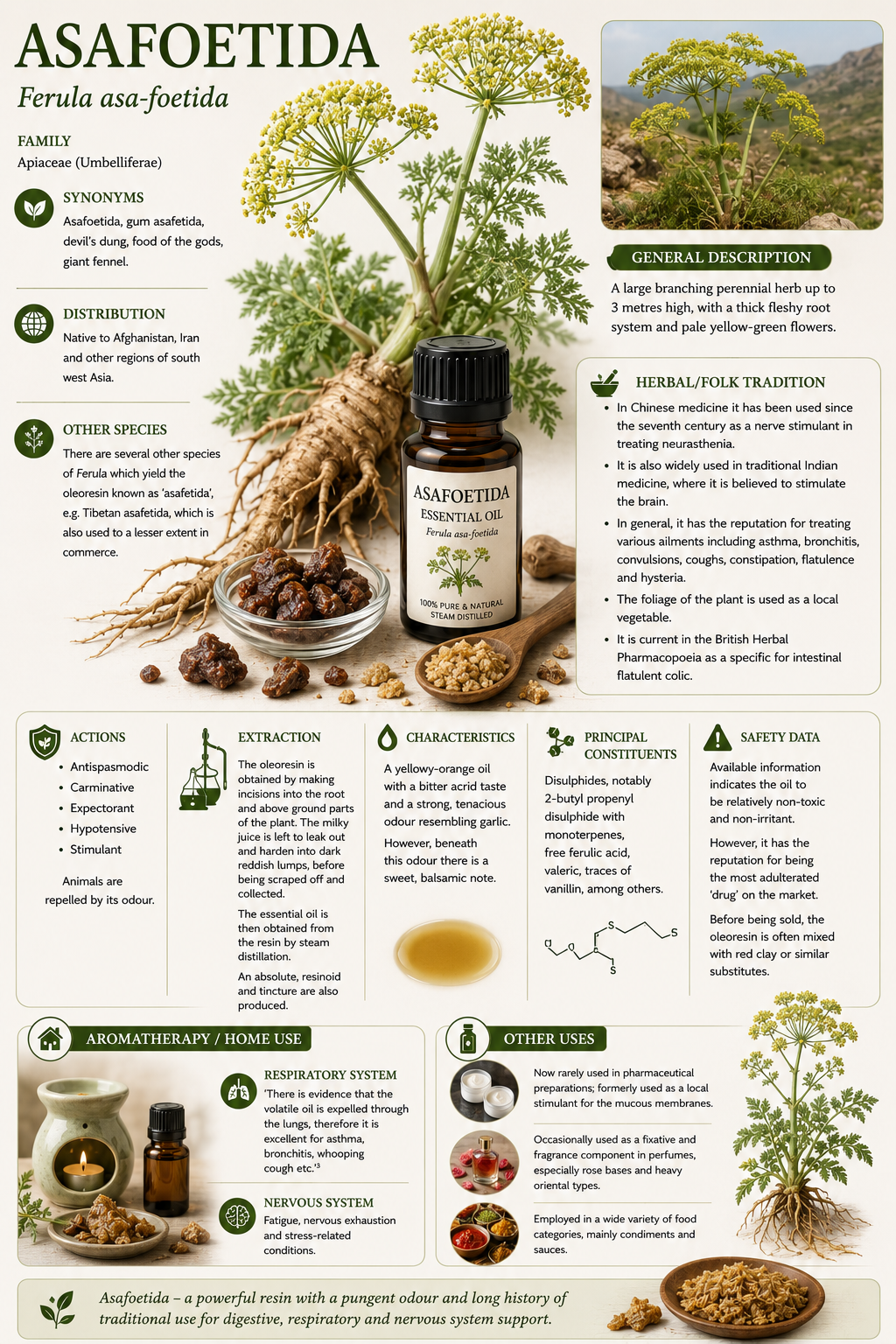
Essential Oil - Asafoetida
Essential Oil – Asafoetida
Botanical Information
Asafoetida (Ferula asa-foetida) belongs to the Apiaceae (Umbelliferae) family and is a large, branching perennial herb that can grow up to 3 metres in height. It has a thick, fleshy root system and produces clusters of pale yellow-green flowers. The plant is also known by several common names, including asafoetida, gum asafoetida, devil’s dung, food of the gods, and giant fennel.
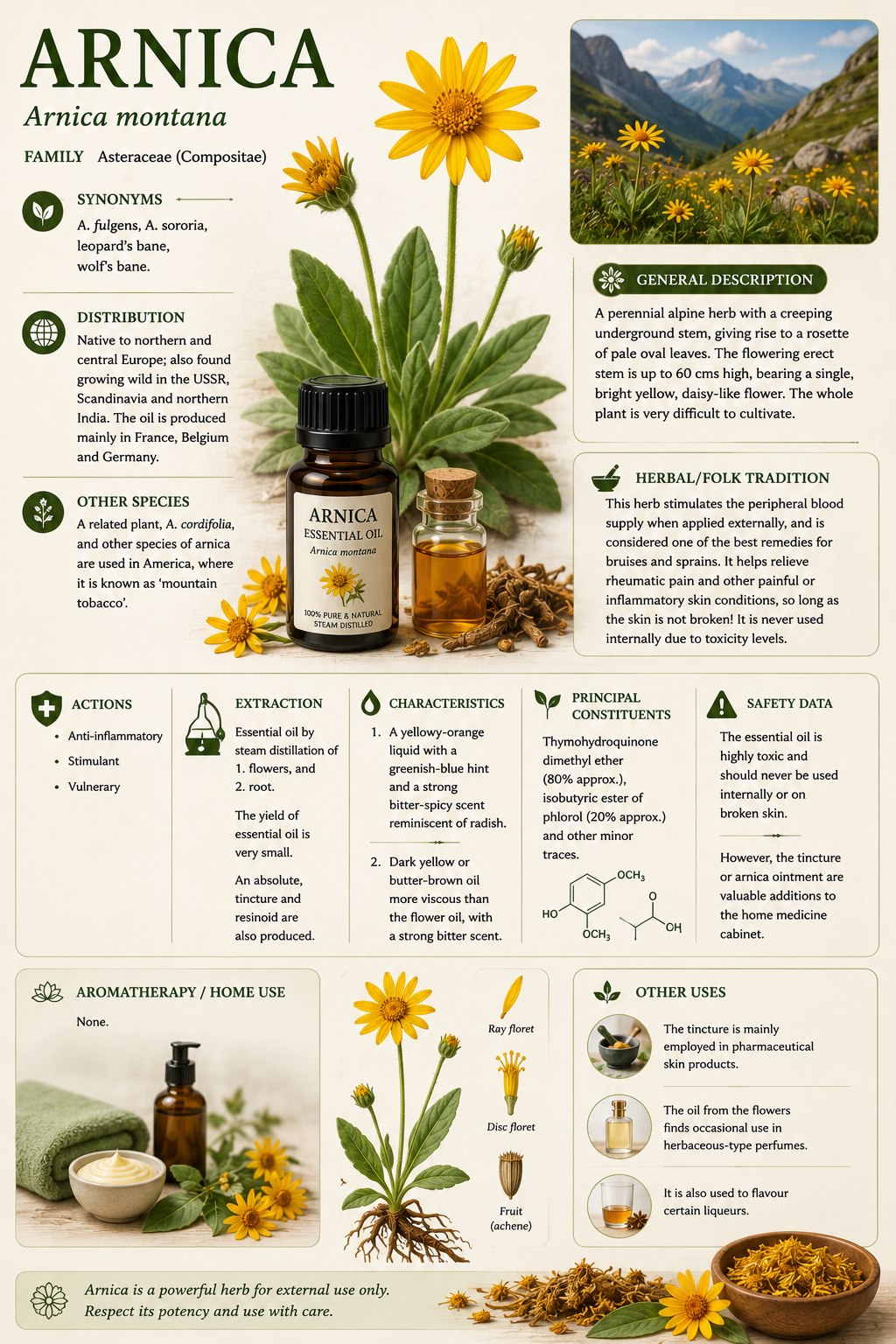
Essential Oil – Arnica
Essential Oil – Arnica
Botanical Information
Arnica (Arnica montana) belongs to the Asteraceae (Compositae) family and is a perennial alpine herb with a creeping underground stem that produces a rosette of pale green, oval-shaped leaves. Its upright flowering stem can reach up to 60 centimetres in height and bears a single bright yellow, daisy-like flower. The plant is well known for its medicinal value but is considered difficult to cultivate. It is also known by several other names, including Arnica fulgens, Arnica sororia, leopard’s bane, and wolf’s bane.
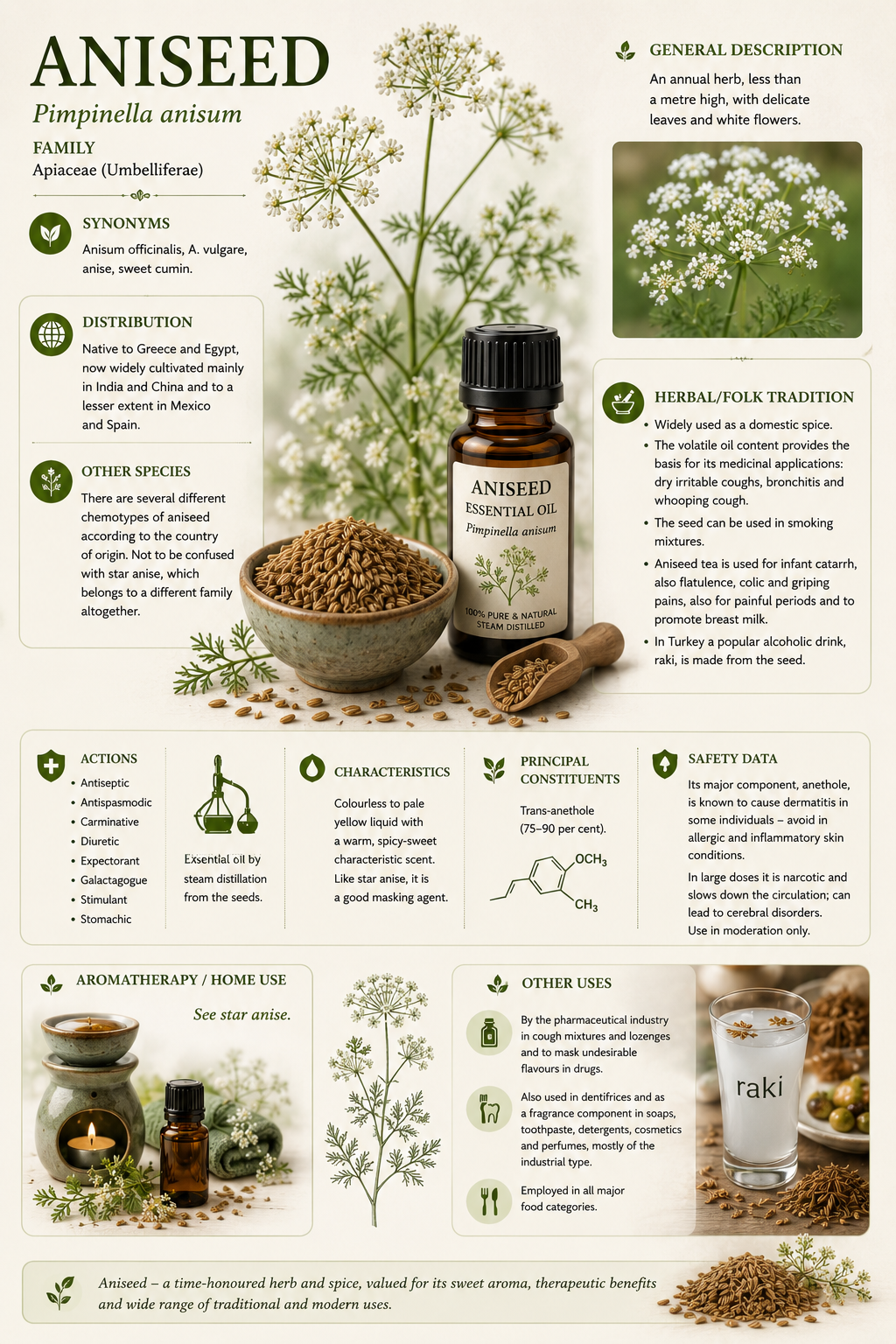
Essential Oil – Aniseed
Essential Oil – Aniseed
Botanical Information
Aniseed (Pimpinella anisum) belongs to the Apiaceae (Umbelliferae) family and is an annual herb that grows to less than one metre in height. It is characterized by its delicate green leaves and clusters of small white flowers. The plant is also known by several scientific and common names, including Anisum officinalis, A. vulgare, anise, and sweet cumin.
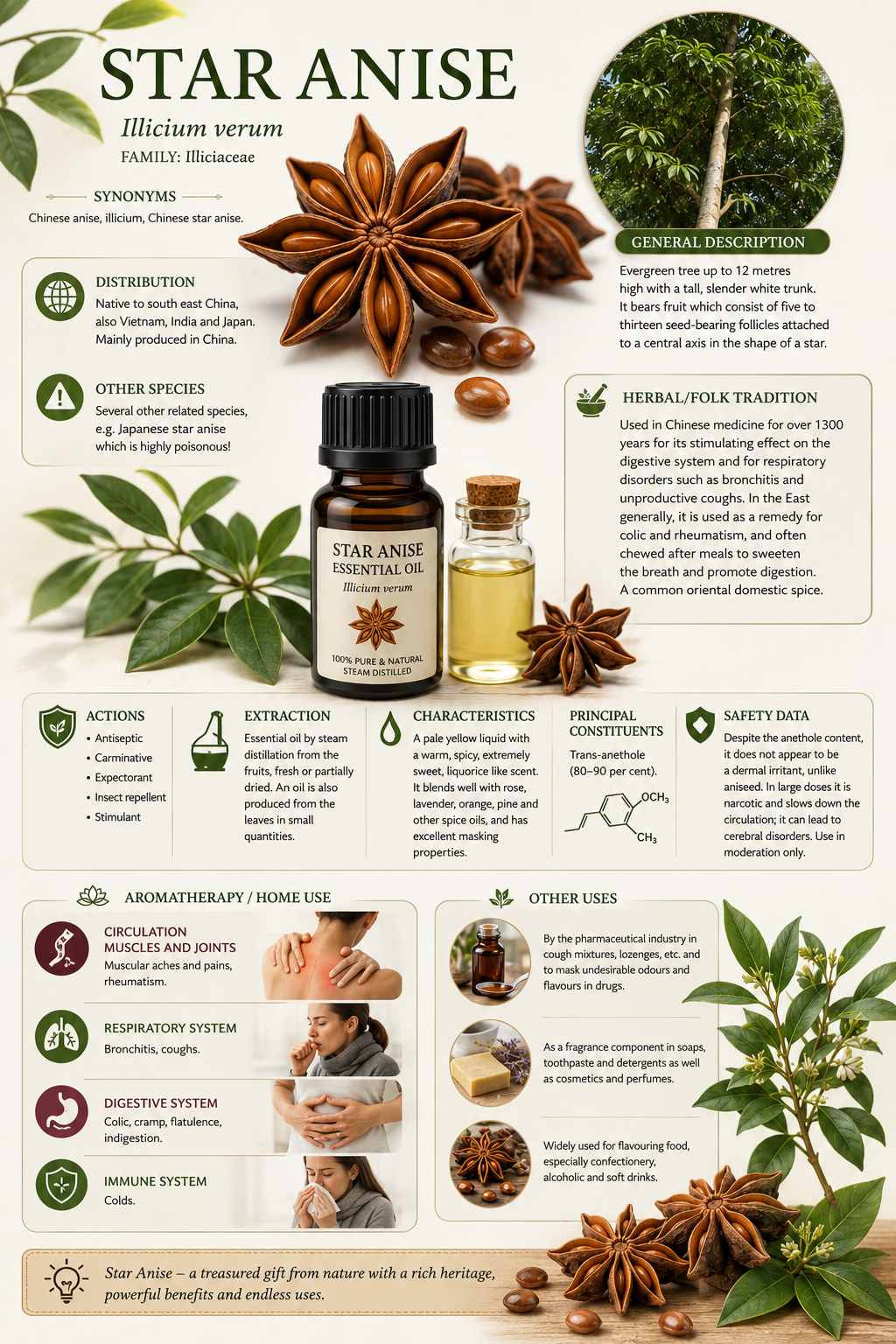
Essential Oil – Star Anise
Essential Oil – Star Anise
Botanical Information
Star Anise (Illicium verum) belongs to the Illiciaceae family and is an evergreen tree that can grow up to 12 metres in height. It has a tall, slender white trunk and produces distinctive star-shaped fruits made up of five to thirteen seed-bearing follicles attached to a central core. The plant is also known by several common names, including Chinese anise, illicium, and Chinese star anise.
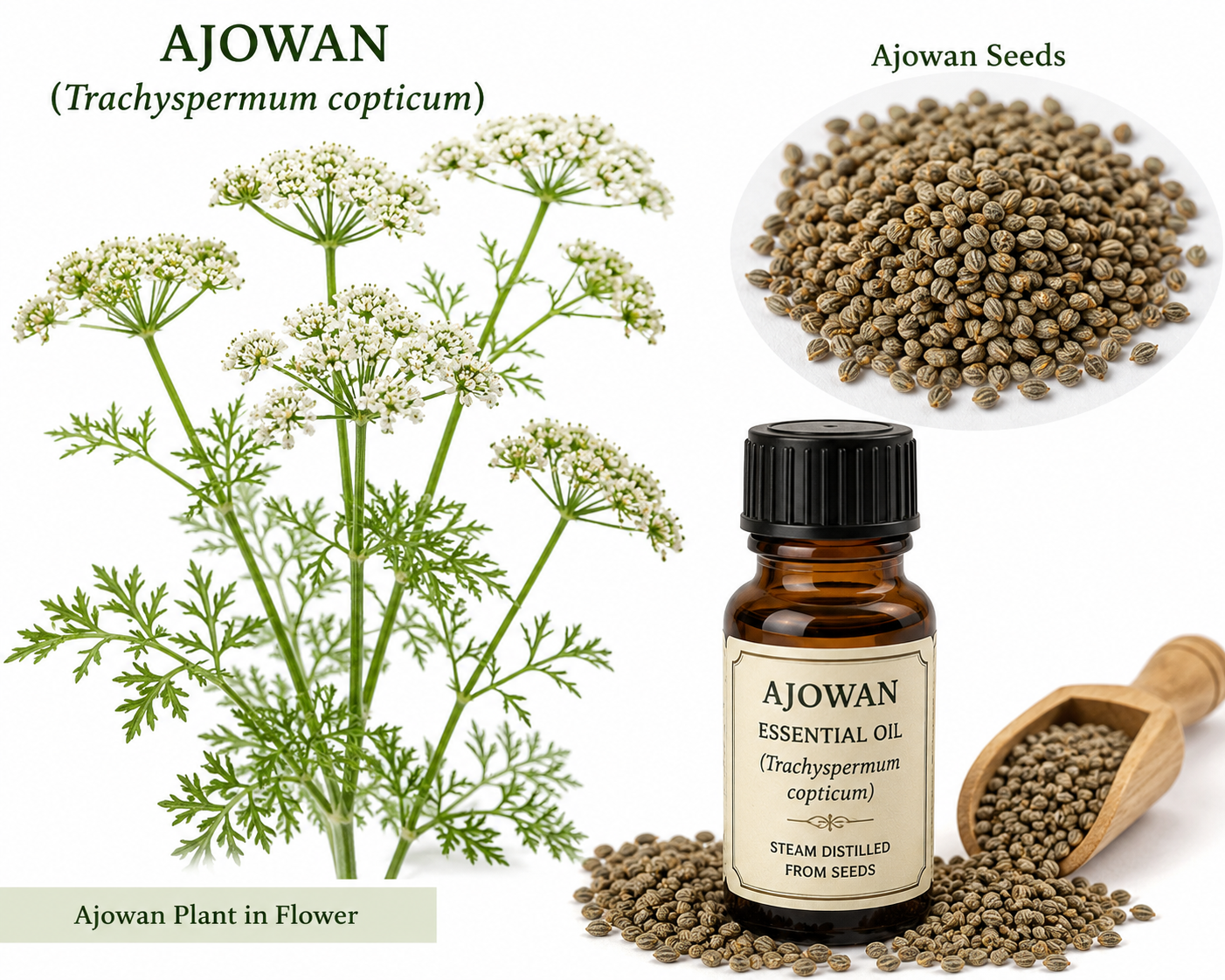
Essential Oil - Ajowan
Essential Oil – Ajowan
Botanical Information
Ajowan (Trachyspermum copticum) belongs to the Apiaceae (Umbelliferae) family and is an annual herb recognized by its small greyish-brown seeds, which resemble parsley seeds in appearance. The plant is also known by several scientific synonyms, including T. ammi, Ammi copticum, Carum ajowan, C. copticum, and Ptychotis ajowan. Its common names include ajuan and omum.
Essential Oil – Allspice
Essential Oil – Allspice
Botanical Information
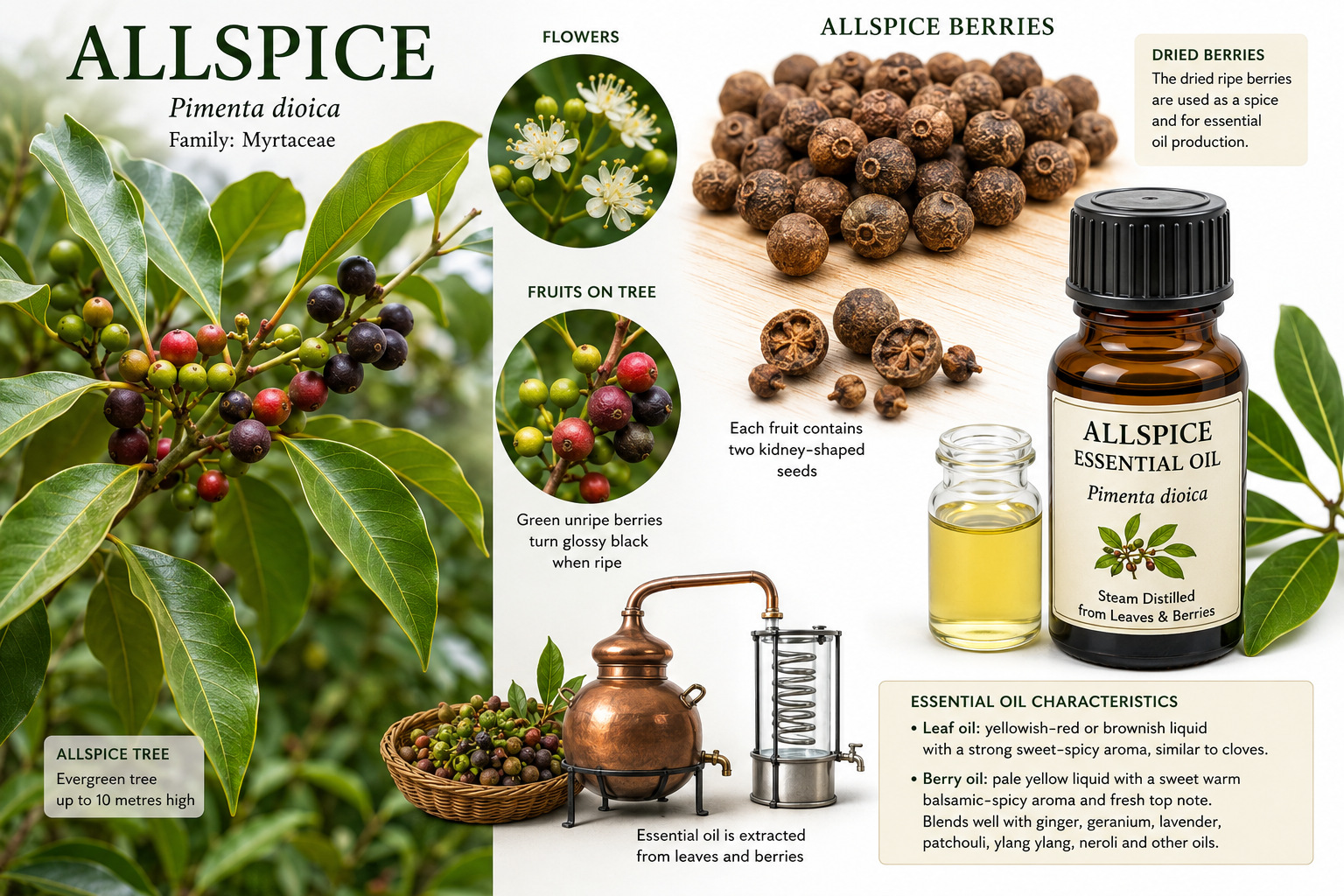
Allspice (Pimenta dioica) belongs to the Myrtaceae family and is an evergreen tree that can grow up to 10 metres in height. The tree begins bearing fruit around its third year of growth. Each fruit contains two kidney-shaped green seeds that gradually turn glossy black when fully ripe. It is also known by several other names, including Pimenta officinalis, pimento, pimenta, and Jamaica pepper.
Essential Oil - Ambrette Seed
Essential Oil – Ambrette Seed
Botanical Information
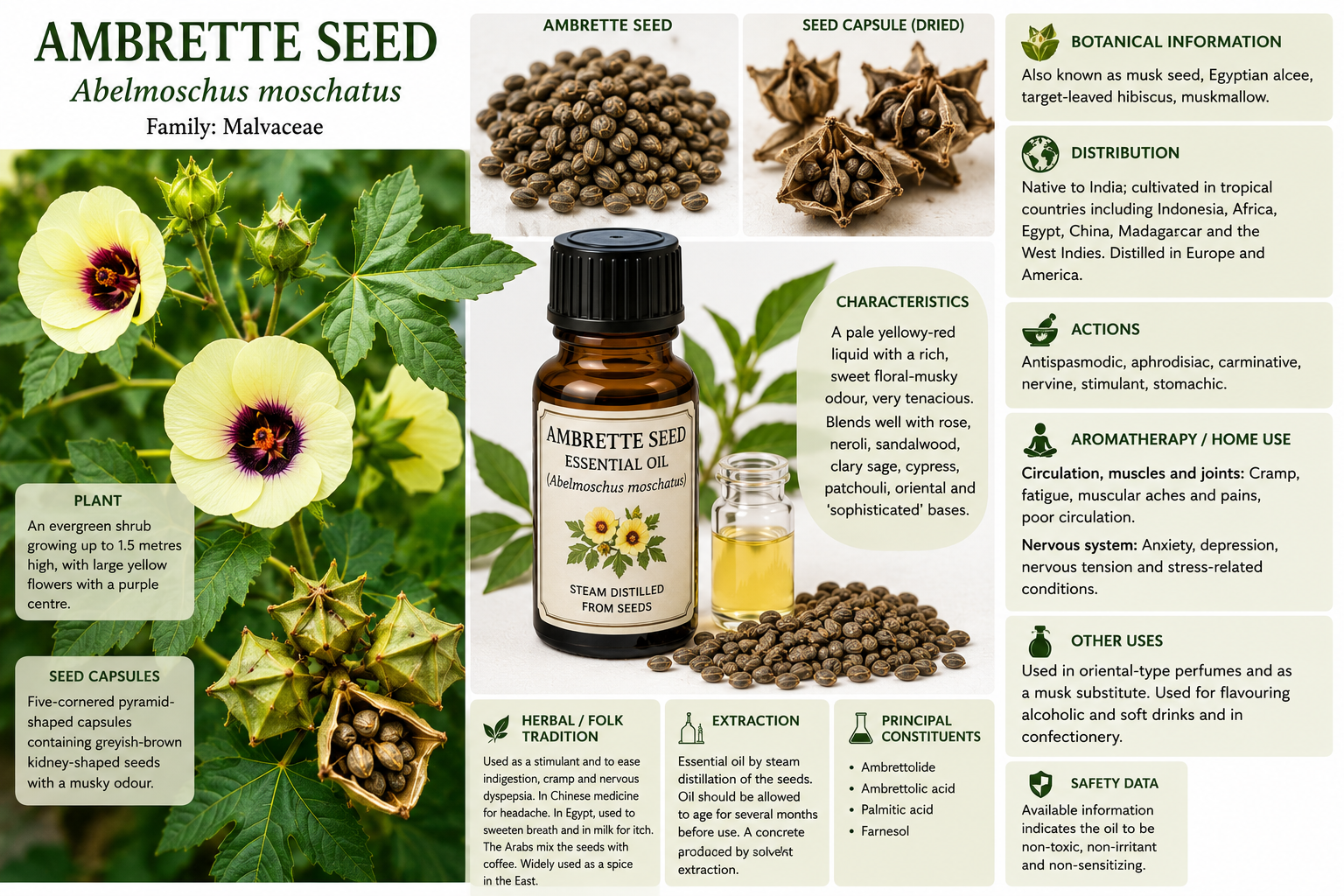
Ambrette Seed (Abelmoschus moschatus) belongs to the Malvaceae family and is an evergreen shrub that grows to approximately 1.5 metres in height. It produces large yellow flowers with distinctive purple centres and pyramid-shaped seed capsules containing greyish-brown, kidney-shaped seeds. These seeds are well known for their characteristic musky fragrance. The plant is also referred to by several other names, including Hibiscus abelmoschus, musk seed, Egyptian alcee, target-leaved hibiscus, and muskmallow
Essential Oil - Amyris
Essential Oil – Amyris
Botanical Information
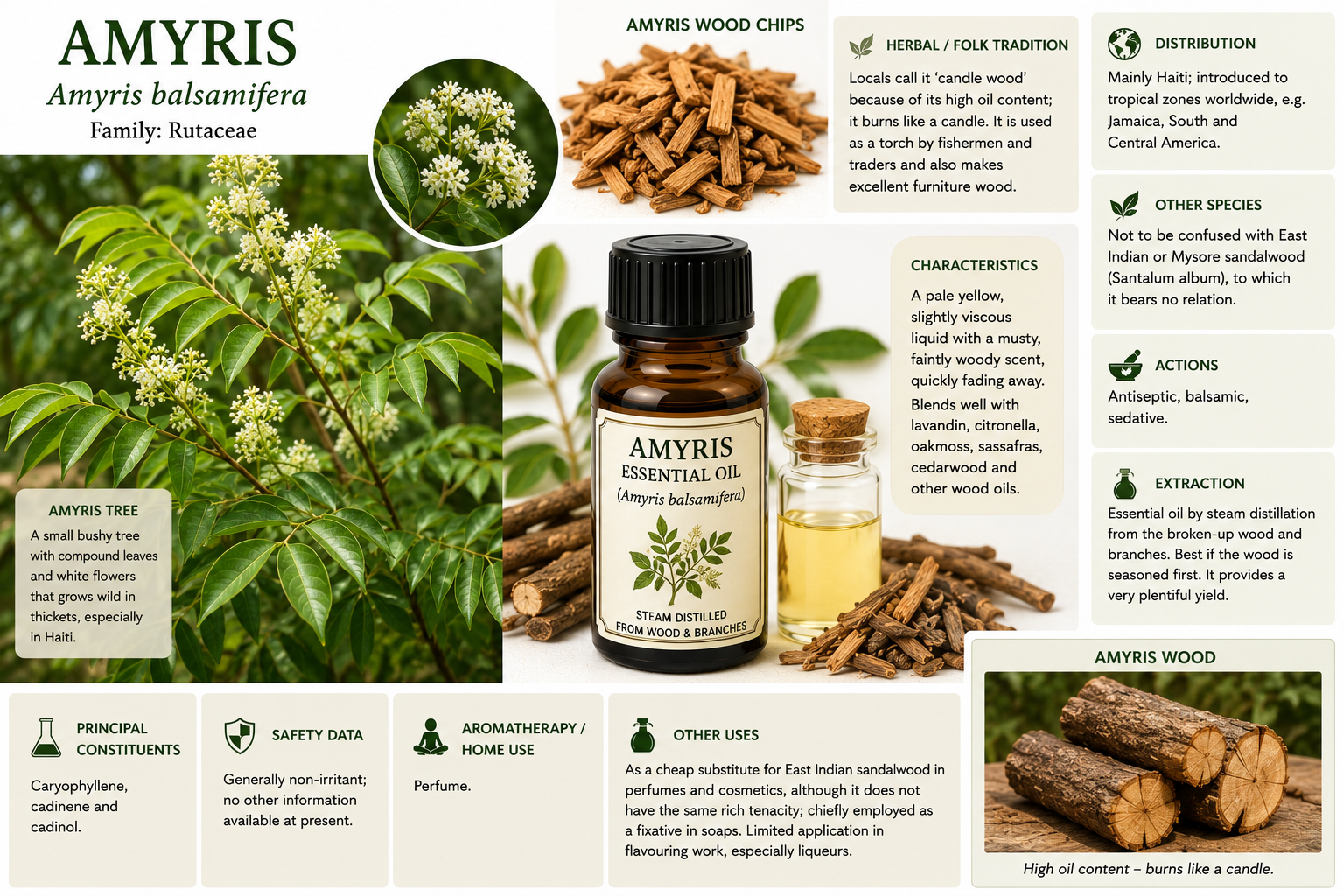
Amyris (Amyris balsamifera) belongs to the Rutaceae family and is a small, bushy tree with compound leaves and clusters of white flowers. It grows naturally in dense thickets, particularly on the island of Haiti. The plant is also known by several other names, including Schimmelia oleifera, West Indian sandalwood, and West Indian rosewood. Despite its common name, Amyris is not botanically related to true East Indian or Mysore sandalwood (Santalum album).
Essential Oil - Angelica
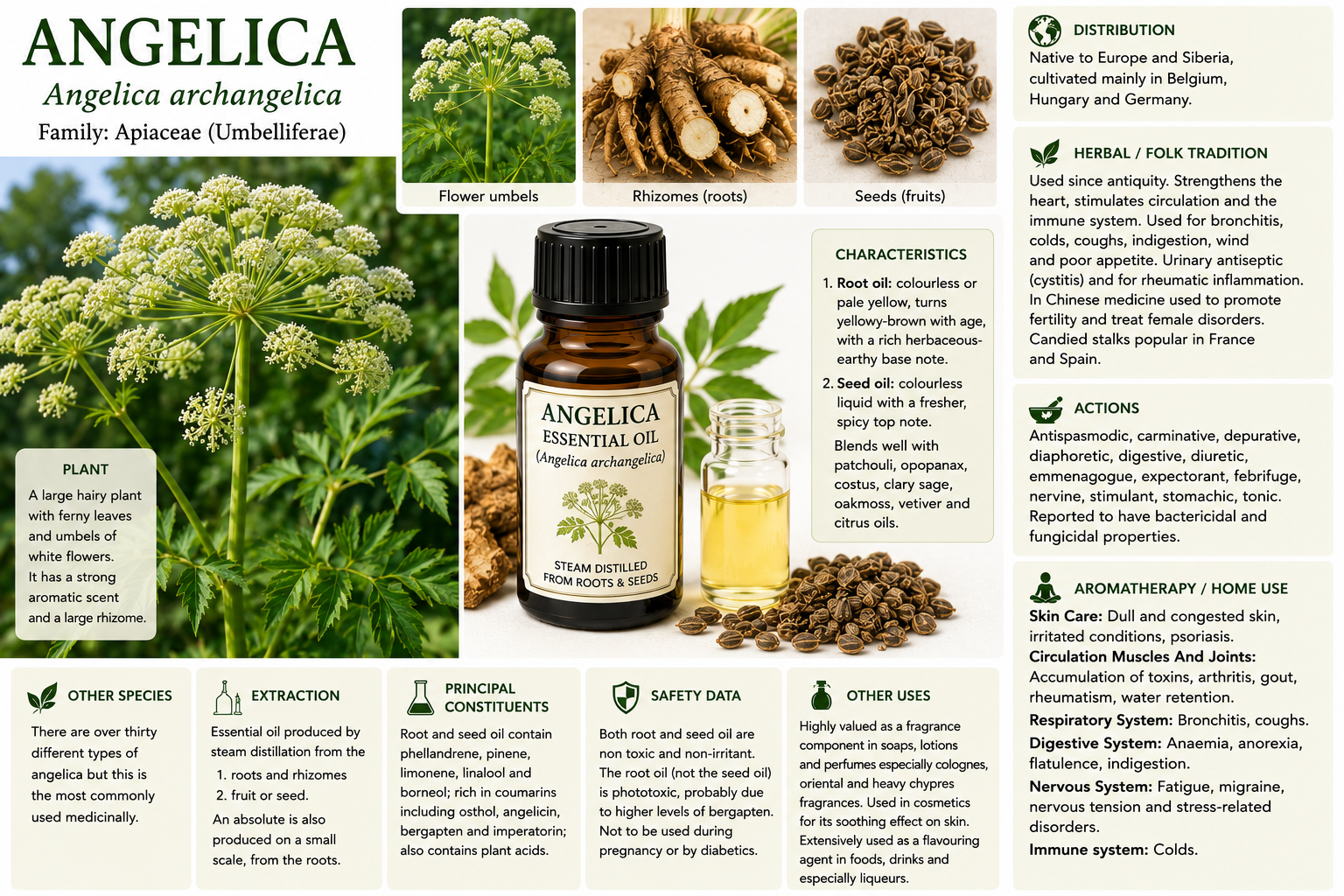
Angelica (Angelica archangelica) belongs to the Apiaceae (Umbelliferae) family and is a large, aromatic herb characterized by its hairy stems, fern-like leaves, clusters of white flowers arranged in umbels, and a thick rhizome. It is also known by the synonyms Angelica officinalis, European angelica, and garden angelica. Although more than thirty species of angelica exist, Angelica archangelica is the variety most commonly used for medicinal and essential oil purposes.